
Collierville Previous Residents by Era
Past residents are easier to trace when each source is assigned to its own period and purpose. The Register provides the current recorded-transfer trail, but it does not publish one blanket oldest online deed year. The regional directory shelf reaches much farther back for household and address clues, and the released federal census can test a household around a directory year. The table separates known collection dates from unknown or collection-specific coverage, so a reader does not mistake a modern search screen for a complete historic archive.
| Source | Years it covers | Where held | What it shows |
|---|---|---|---|
| Register deed/property search | Live index; earliest blanket deed year not published; archive series vary | Shelby Register and Archives | Transfers, parties, legal descriptions, dates, instrument/book/page |
| Memphis city directories | 1849–1994; digital Register run 1849–1943 | Memphis/Shelby County Room and Register links | Names, occupations, and address continuity |
| Suburban directories | 1964–1994; confirmed Collierville years include 1971, 1972, 1975, 1989, 1991 | Memphis/Shelby County Room and cataloged microfilm | Collierville household or business clues |
| Federal census | Released schedules through 1950; library emphasis on 1900, 1910, 1920 | NARA, library, and genealogy resources | Household, age, birthplace, occupation, and enumeration context |
| Collierville Herald | March 1, 1929–1980 | Morton Museum searchable PDFs | Obituaries, notices, civic and address events |
| Sanborn maps | 1892, 1897, 1902, 1907, 1913 collections located | Library of Congress and local map collections | Building footprints, street labels, public and business structures |
| Probate | Online database 1970 forward; older local series vary | Probate Clerk, Archives, library microfilm | Wills, estates, heirs, administrators, property links |
Start with the Register if the property is recent enough to have a current parcel and transfer trail. Begin with a directory or map if the question is historical and the address may have changed. For a death, estate, or family connection, the Herald and probate file can close a gap that land records leave open.
Note: A missing directory year can reflect a publication or catalog gap, not proof that a household left the address.
Start a Collierville Address With a Parcel
The first modern record should be the Shelby Register GIS parcel detail. Search by street number and street name, then capture the situs address, current owner, parcel ID, tax map, lot, subdivision, plat book and page, and linked sales or deed references. The situs is the physical location. The owner address is a tax correspondence field and may belong to a trust, company, agent, or an owner outside Collierville. It is not proof that the owner lived at the property.
A parcel ID and legal description are especially useful for previous residents research because a historic deed may use a lot, subdivision, metes-and-bounds description, or earlier road name instead of today’s street address. The Shelby County Assessor links the public property and GIS tools used to confirm the tract. Note current owner names exactly, including co-owners, trust names, and company names, before moving into the deed index.
Trace Collierville Previous Residents Through Deeds
Deeds do not list every household member, but they supply the ownership timeline that gives later sources a reliable date range. The Shelby Register index accepts party names, parcel, lot, subdivision, address, ZIP, document number, book/page, date and consideration ranges, plus instrument and document-type filters. A transfer can be a warranty deed, trust deed, quitclaim, substitute trustee deed, affidavit, or another instrument. Read the document type in context rather than assuming every recorded transfer was an ordinary sale.
The Shelby Register live lookup is the index path for this work. Its current screen says instruments were verified through April 20, 2026. That status does not establish an earliest deed year, and older books, images, and archive collections can require a visit or a request.
- Open the current parcel and save its legal description, parcel ID, owner, and most-recent instrument reference.
- Find the owner’s acquisition document. Record the grantor, grantee, recording date, instrument number, book/page, consideration, and document type.
- Search that seller as a grantee in an earlier date window. Use the parcel, subdivision, lot, or legal description to separate a similar name from the right tract.
- Repeat the earlier-grantee to earlier-grantor step, noting married-name variants, trusts, estates, and companies as separate indexed forms.
- If the address fails, remove direction and street type as the Register instructs, then use the legal description and ask the Register Archives about older index books or microfilm.
The source image is the Shelby Register deed-index screen, with controls for parties, parcel, address, ZIP, instrument, book/page, and date range.
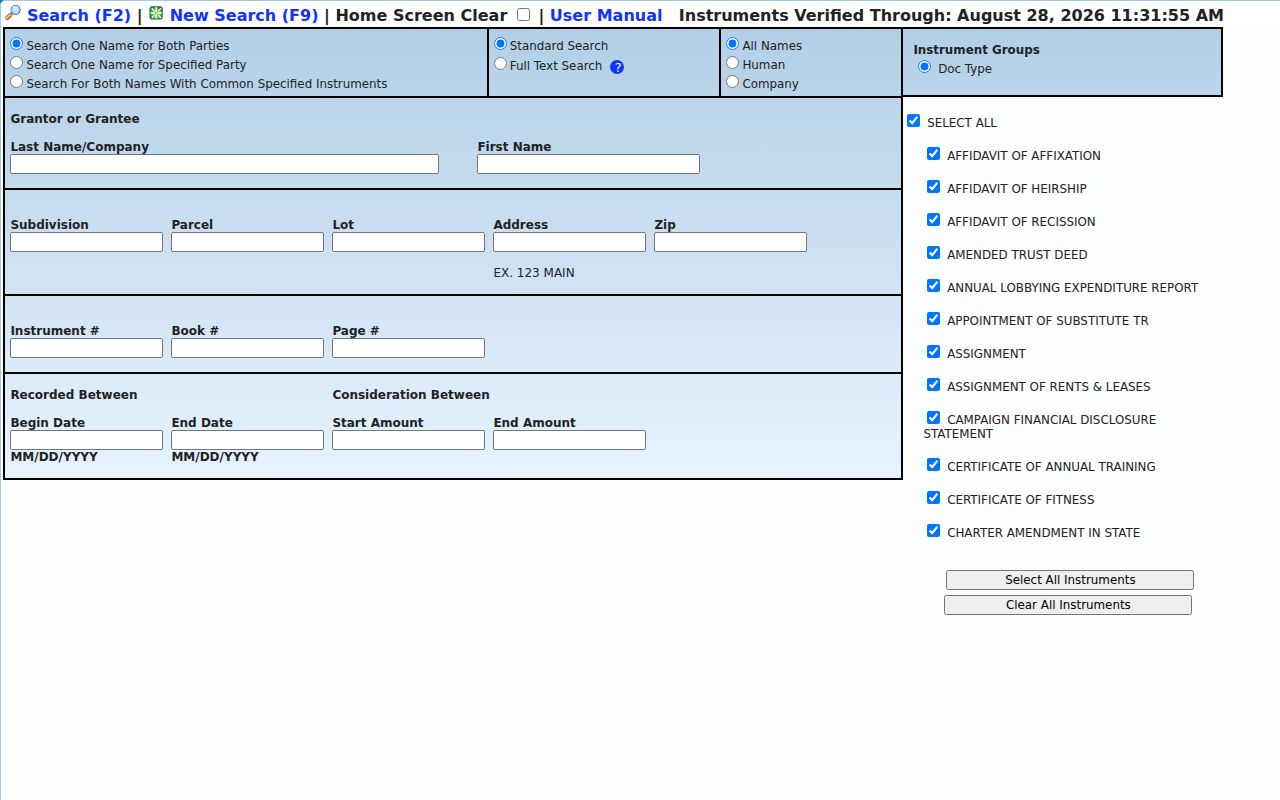
The index does not promise an automatic chain of title. Each earlier owner must be tested against the parcel and legal description before it is placed in the Collierville address timeline.
Define Collierville Address-History Terms
The deed trail uses a few terms that are easy to reverse. Keep them clear before attaching a past owner or household to an address. A recorded name establishes a role in a transaction, while the address and legal description establish which property the transaction concerns.
- Grantor
- The party transferring an interest in the instrument. In a purchase deed, this is generally the seller.
- Grantee
- The party receiving an interest. A former seller can be found in an earlier document as a grantee.
- Chain of title
- The manually checked sequence of recorded transfers for the same tract. It can include sales, estates, trusts, foreclosures, or title-cleanup documents.
- Legal description
- The lot, subdivision, plat, metes-and-bounds, or parcel description that anchors a property when a street label or number changes.
- Criss-cross directory
- A historical street-and-number index that may point from an address to a household or business in one printed edition.
Use the legal description with the address in every old-record search. It is the best way to avoid mixing a Collierville previous residents trail with a similar street name or a different subdivision.
Pair Collierville Previous Residents With Census
Once a deed suggests an ownership period, household sources can test who lived there. Memphis Public Libraries documents city directories from 1849 to 1994 and suburban directories from 1964 to 1994. The confirmed cataloged suburban editions for Collierville are useful checkpoints, but they do not prove that every year survives or that a person stayed continuously at the address. Search the closest street section, then the alphabetic entry, and preserve the edition year and page number.
Use the recorded address or directory entry to locate the nearest released census. The local-history research emphasizes Shelby County microfilm for 1900, 1910, and 1920. Compare spouse, children, ages, birthplace, and occupation to distinguish same-name households. Census boundaries and rural-route labels can differ from modern Town limits, so an address relationship must be tested rather than assumed.
- Match the deed date or parcel history to the nearest directory year.
- Check the street-and-number section and the alphabetic name section, including common directional or suffix variations.
- Find the closest released census entry and compare the household details with the directory record.
- Return to a later directory and deed to check whether the household moved, the property changed hands, or an edition is missing.
The historical collections and reading an edition in detail are on the Collierville city directory page. This address trail uses those sources as dated household evidence rather than rebuilding the collection shelf.
Note: Census boundary labels can differ from modern Town limits, so compare the household details before accepting an address match.
Use Collierville Home-History Sources
Memphis Public Libraries publishes Researching Your Home, a practical path that brings together street and plat maps, Sanborn maps, city and suburban directories, census records, newspapers, title/deed leads, historic-house files, photographs, and neighborhood studies. It also directs researchers to the Assessor for tax records and to the Register for early land deeds, rather than treating the library as the custodian of every property record.
The source image is the Memphis Public Libraries house-history guide.
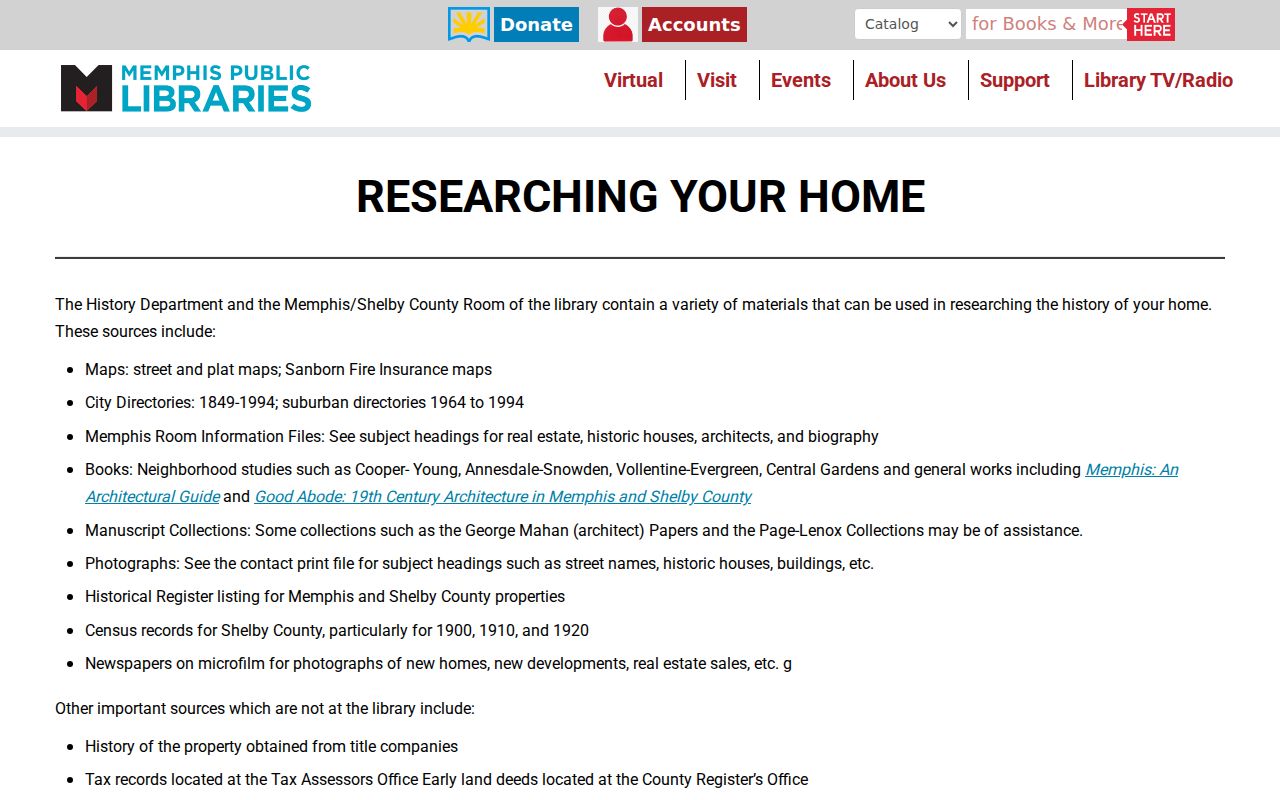
The guide makes a useful division of labor: deeds and taxes help identify the property, while directories, maps, newspapers, and local files help place people and events around it.
Date Collierville Address-History Buildings
Sanborn maps date the built environment, not the people inside it. Collierville sheets have been located for 1892, 1897, 1902, 1907, and 1913. The 1902 Library of Congress sheet is a one-sheet October 1902 Sanborn Map Company item in the public domain. It can show an old street label, building footprint, and public or business structure that helps bridge an older address to a modern parcel.
Pair a map result with a plat, deed, directory, newspaper, or census record before drawing a conclusion about former residents. A structure on a map shows that a building or feature existed. It does not identify the people who occupied a private building at that time.
Close Collierville Previous Residents Trails
The Morton Museum of Collierville holds searchable Collierville Herald PDFs from March 1, 1929 through 1980, plus photographs and records tied to local agricultural and manufacturing history. Search surname variants, initials, street names, and business names. An obituary, civic notice, sale notice, or advertisement can provide a date and community connection, but it should be read with the deed and directory evidence already gathered.
Probate can connect a prior owner to heirs or an administrator when the deed trail shifts through an estate. Shelby Probate’s online database reaches 1970 forward, split between Case Information for files closed before September 30, 2013 and Case Information II for open or post-October 1, 2013 files. Wills are not viewable online; order them from the Probate Clerk. Older probate sources are held through the Archives and library microfilm routes.
Note: The Herald can supply a local event or name lead, but it does not replace a recorded deed, certificate, or complete probate file.
Bridge Collierville Address-History Gaps
Address continuity in Collierville has two documented traps. No official source located a single street-renumbering year. The safe method is to compare old street labels, adjacent intersections, subdivision or lot, recorded legal descriptions, Sanborn sheets, Town maps, and directory street sections. Do not state that an address was renumbered without a Town or county record that establishes it.
Town boundary changes matter too. The Collierville Reserve Area is unincorporated land inside the Town’s Urban Growth Boundary, and the Town lists annexations in 2012, 2016, 2017, 2019, 2020, and 2022. Building and Code services begin on the effective annexation date. Consult the annexation history and the Town map gallery when a historic Collierville mailing city and present Town record do not line up.
Note: A current Collierville mailing city does not, by itself, show which office held an older permit or code record.
Limit Collierville Previous Residents Results
Previous residents research can build a careful house history, family history, estate trail, or account of a property’s past. It cannot prove a complete household from an owner name, a directory line, a map, or a single voter entry. Recent vital records have statutory access limits, some records are sealed or redacted, and Safe at Home addresses have special protection. Confirm an important finding with the custodian that holds the source record.
Keep living people out of speculative address histories. A dated directory, census return, obituary, or deed should be treated as a record of its own time, not as a present-day location claim.
Lawful use. Collierville house-history research is for personal, lawful purposes. Do not use past-address information to stalk, harass, intimidate, or harm any person.